Demonstrations · Made-up material
Tender response: compliance matrix, first drafts and a gaps list
Claude reads a public-sector tender and the firm's bid library, maps every requirement to evidence, drafts two scored sections inside their word limits, and lists what the bid team still has to fix.
This is a demonstration. The business, people, documents and figures are made up for this example. It is not client work.
Relevant to: Engineering, construction and other consultancies that bid for public-sector work, especially bid managers and the directors who sign off bids.
The made-up situation
Harlow Quinn, a 48-person consulting engineering firm with offices in Galway and Dublin, wants to bid for Lisbrack County Council's tender for design and supervision of a 4.2 km walking and cycling route (RFT LCC/AT/2026/014). The deadline is 12 November 2026 and clarification questions close on 30 October. The tender has eight pass/fail requirements and four scored quality questions, each with a word limit.
The firm keeps its bid material in SharePoint: a company information sheet, project sheets and two-page CVs. Orla Fitzgerald, the bid manager, would normally spend the first day or two of a bid pulling this together by hand.
Step by step
1Ask Claude to read the tender and the library
Orla opens Claude, which has the Microsoft 365 connector switched on, and types:
What the person types Read the attached RFT for the Carrowmeen to Lisbrack Active Travel Scheme. Then search our SharePoint Bids library (Standard Information, Project Sheets, CVs and the Q4 resource plan) for evidence against every mandatory requirement and quality criterion. Build a compliance matrix: requirement, evidence found, source file, and status (Met, Check or Gap). Count "last five years" back from the tender deadline. Don't count anything that doesn't meet a threshold, and tell me what you excluded and why.
Claude draws on the tender, the company information sheet, four project sheets, four CVs and the resource plan.
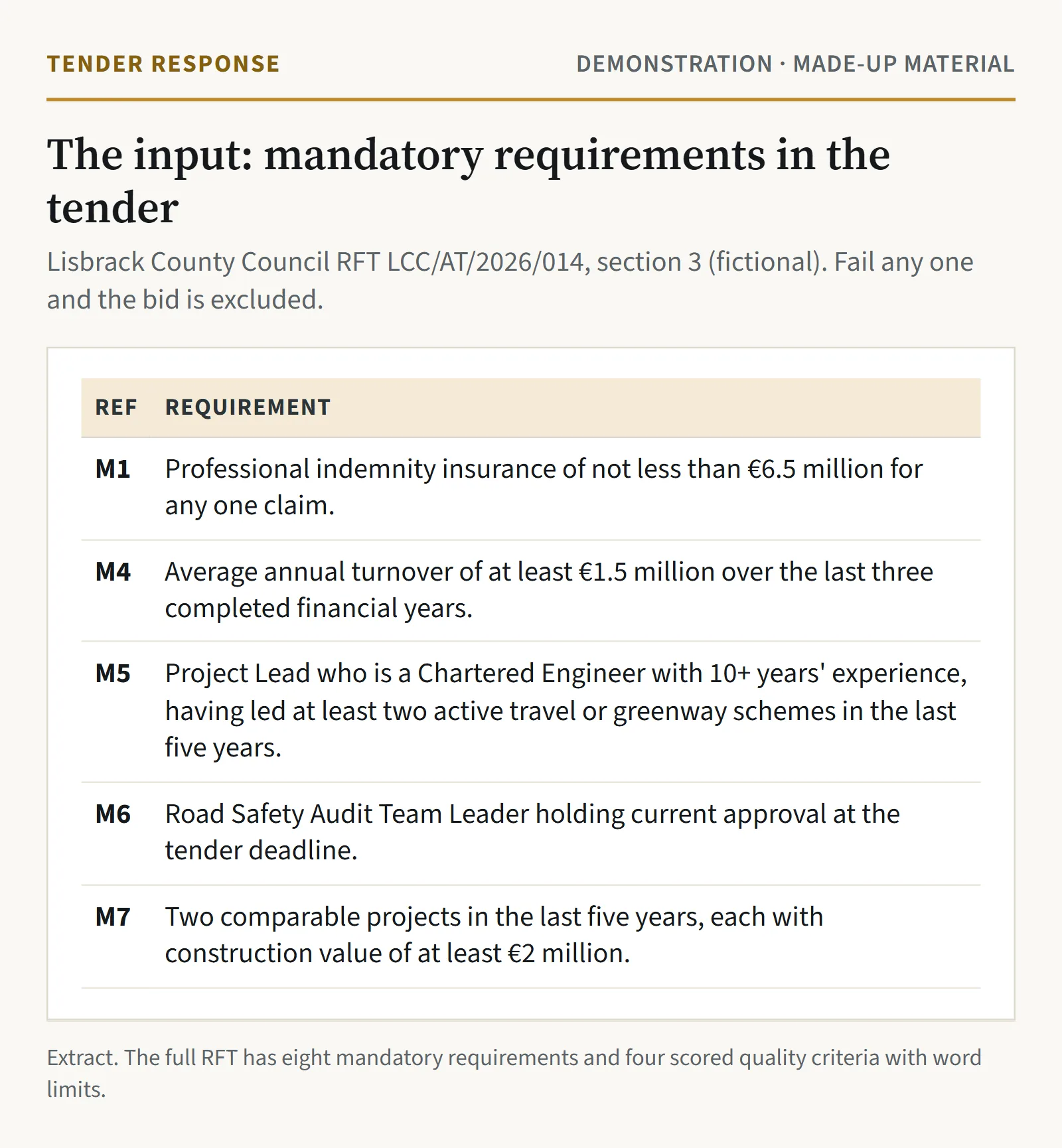
2The compliance matrix comes back
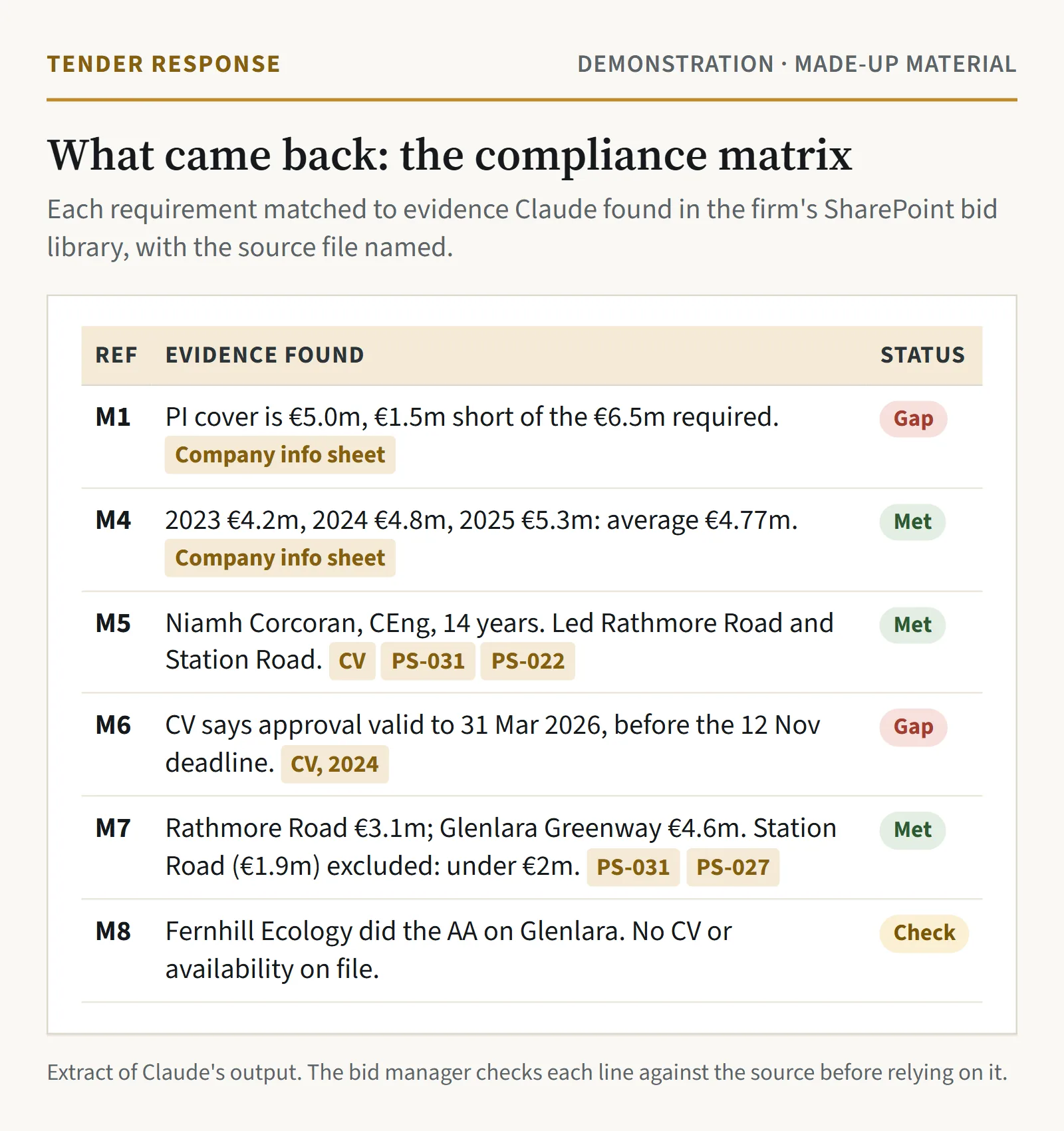
Claude matched each requirement to evidence and named the file it came from. Two pass/fail requirements fail on the evidence in the library:
Ref Evidence found Status M1 PI cover is €5.0m any one claim, €1.5m short of the €6.5m required. Gap M6 Aoife Brennan's CV says her road safety approval is valid to 31 March 2026, before the tender deadline. The CV file is dated 2024 and may be out of date. Gap until renewal is confirmed M7 Rathmore Road (€3.1m) and Glenlara Greenway (€4.6m). Station Road (€1.9m) and Mill Street (€1.4m) excluded: under €2m. Met Claude also saved the full matrix as an Excel file for the bid team.
3Draft two scored sections within the limits
What the person types Draft Q2 (project team, 1,000 words) and Q3 (stakeholder engagement, 800 words). Use only facts from our project sheets and CVs. Where the tender asks for something we don't have on file, leave a bracketed note for the bid team instead of making it up. Give me a word count for each.
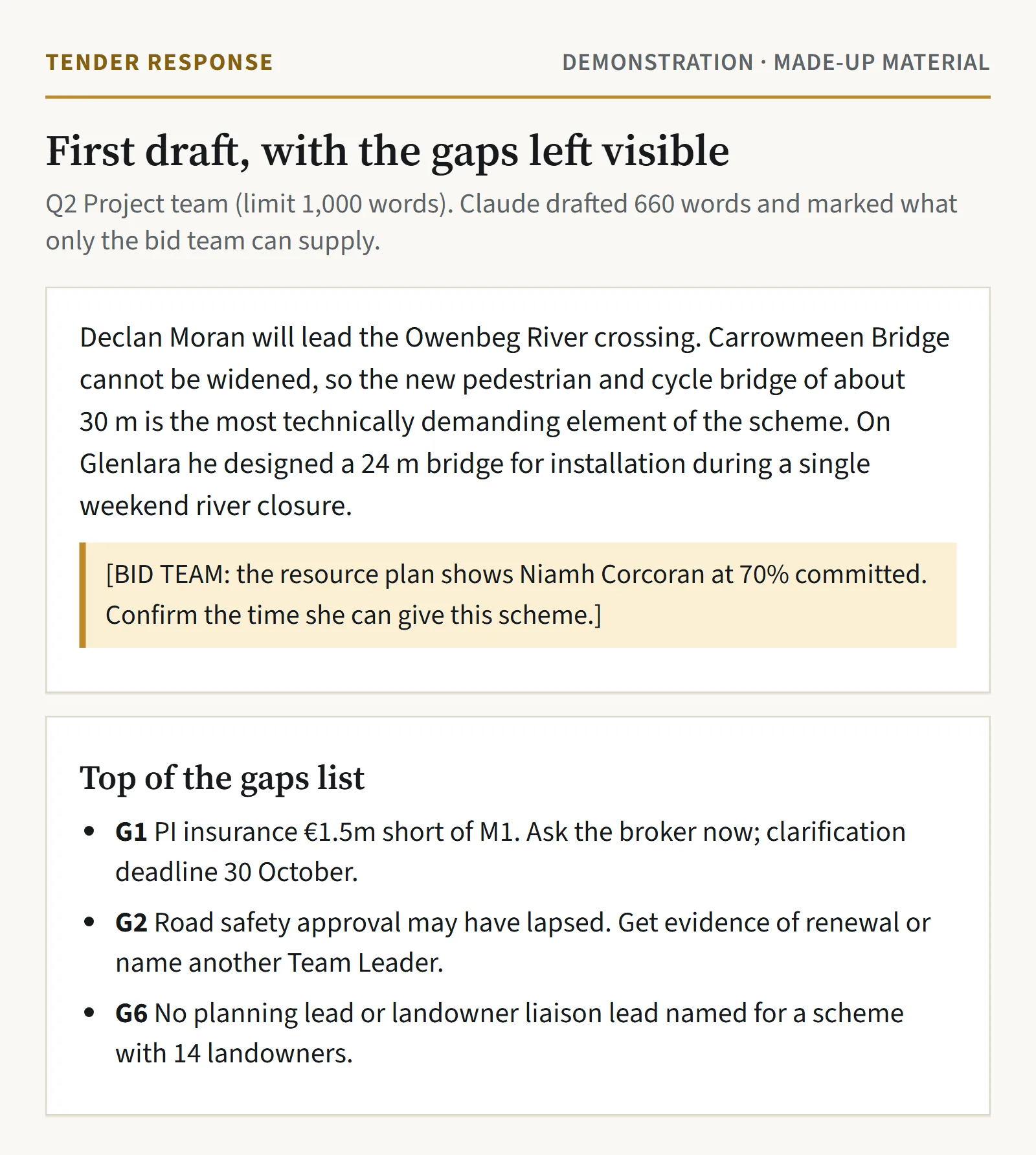
Claude drafted Q2 at 660 words and Q3 at 602 words, counting tables and headings as the tender requires. Of those, 101 words in Q2 and 84 in Q3 are bracketed notes for the bid team. An excerpt from Q2:
Excerpt from Claude's draft Declan Moran will lead the Owenbeg River crossing. Carrowmeen Bridge cannot be widened, so the new pedestrian and cycle bridge of about 30 m is the most technically demanding element of the scheme and the one most exposed to environmental constraints. On Glenlara he designed a 24 m bridge for installation during a single weekend river closure agreed with the fisheries authority.
[BID TEAM: the Q4 2026 resource plan shows Niamh Corcoran at 70% committed and Conor Whelan at 85% until March 2027. Confirm the time each person can commit here...]
4The gaps list
What the person types List every gap the bid team needs to close, in order of risk, with a suggested action and an owner.
Claude returned 11 items. The first three are pass/fail and could get the bid excluded. Others are things evaluators will look for: the Project Lead has about 30% of her time free, there is no named planning lead or landowner liaison lead for a scheme with 14 landowners, and the library has nothing on how schools were consulted on past schemes, which Q3 asks about directly.
5What the bid manager checks and changes
Claude's output is a starting point. Before anything goes into the bid, Orla:
- Opens each source file named in the matrix and confirms the figure or fact is there. This matters most for the pass/fail lines.
- Decides the judgement calls Claude flagged rather than settled, such as whether Mill Street could count as active travel experience, and how to present the Project Lead's limited availability.
- Sends the insurance gap to the broker and the road safety approval to Aoife the same day, because both have to be resolved before 30 October.
- Fills in the bracketed notes with the directors, then reads both drafts aloud against the evaluation criteria in the tender.
- Re-counts the words on the final text. Claude's count is a guide; the tender portal's rules decide.
Time taken
A typical estimate, not a measured result
By hand, building a compliance matrix from a library like this and drafting two quality sections usually takes a bid manager one to two working days: about half a day to find and check evidence and the rest to write. With Claude, the matrix, drafts and gaps list come back in a few minutes. The time that remains is the checking above, which we would expect to take two to three hours for a tender of this size. The saving is mainly in search and first drafting. The decisions stay with the bid team.
How this demonstration was made
We wrote the tender and the firm's bid library for this demonstration. Claude then produced the outputs by reading those files. In a firm's setup the same files would sit in SharePoint and Claude would reach them through the Microsoft 365 connector, as in the first step. We checked every figure, date and source reference in the outputs against the input files.
The source documents and Claude's full outputs are not published here. The excerpts and images on this page show what came back.
Claude features used, with Anthropic's documentation
- The Microsoft 365 connector lets Claude search SharePoint, OneDrive, Outlook and Teams, and read Word, Excel, PowerPoint, PDF and plain-text files from SharePoint and OneDrive. Claude Help Center: Enabling and using the Microsoft 365 connector
- Claude acts with the user's own delegated permissions, so it only sees what that user can already see in Microsoft 365. On Team and Enterprise plans an organisation owner enables the connector first. It needs a work account in a Microsoft Entra tenant, not a personal Microsoft account. Claude Help Center: Enabling and using the Microsoft 365 connector
- Claude can create Excel, Word, PowerPoint and PDF files (used here for the compliance matrix spreadsheet). Claude Help Center: Create and edit files with Claude
Doing this with your own work
For a real team we build the same kind of workflow in your Claude organisation, test it on your past work and train the people who will use it.
That is usually a workflow implementation. Ways to start sets out what it includes and what we need from you.
Talk to us about a piece of work like this
Tell us what the work is and who does it now. We'll suggest a time for a short call.