Demonstrations · Made-up material
Client file review: chronology, key issues and points for judgement
Claude reads a ten-document client file on a supplier dispute and produces a chronology, a summary of the key issues and a list of the points a solicitor has to decide, with every statement tied to the document it came from.
This is a demonstration. The business, people, documents and figures are made up for this example. It is not client work.
Relevant to: Law firms and accountancy practices that review document-heavy client files, such as disputes, onboarding or due diligence. It suits the partner or solicitor with conduct, and the trainee who would normally do the first pass. Nothing here is legal advice.
The made-up situation
On the evening of 9 September 2026, Fiona Ashe, managing director of Ashgrove Kitchens, emails her solicitor Ruairí Keane. A timber supplier's solicitors are demanding €57,564 for 180 worktop panels within 14 days. Ashgrove withheld payment because the veneer started lifting after fitting. She attaches everything she has: the supply agreement, the purchase order, the delivery docket, three emails, the invoice, the supplier's inspection report and the solicitor's letter. With her own email, that makes ten documents.
Ruairí needs to understand the file and advise before the 16 September deadline.
Step by step
1Put the file where Claude can read it
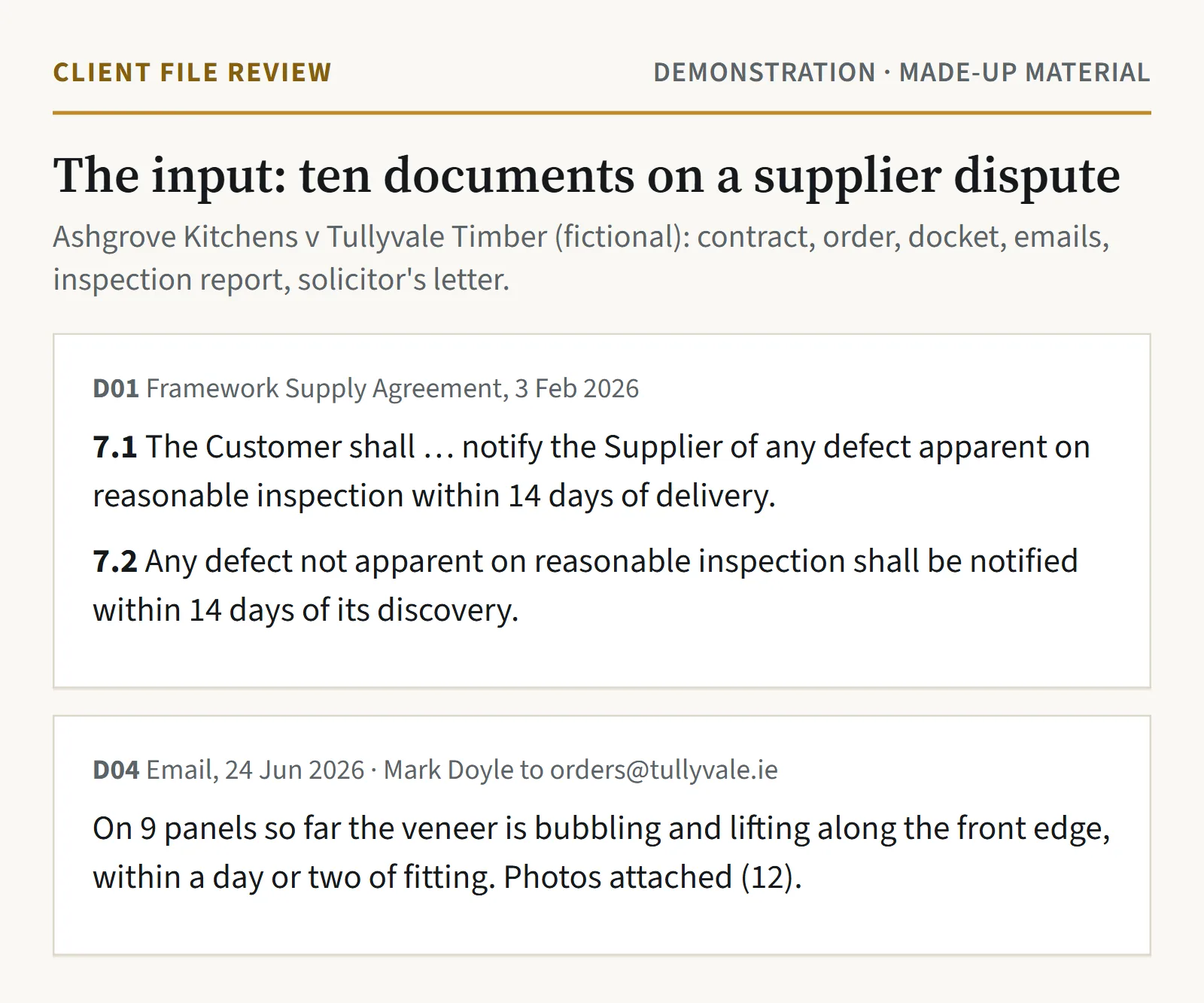
Ruairí's trainee adds the ten documents, numbered D01 to D10, to a Claude Project for the matter. The Project instructions say to cite a document number, and clause or paragraph where there is one, for every statement.
So a reference such as "D01 cl. 7.1" below means clause 7.1 of document 1 in this made-up file (the supply agreement), and "D08 §2.2" means paragraph 2.2 of document 8 (the inspection report).
2Ask for a chronology
What the person types Build a chronology of this matter from D01 to D10. One row per event: date, what happened, source document and clause or paragraph. Add the contractual deadlines that follow from the agreement and mark them as calculated. Then reconcile the panel numbers across the file.
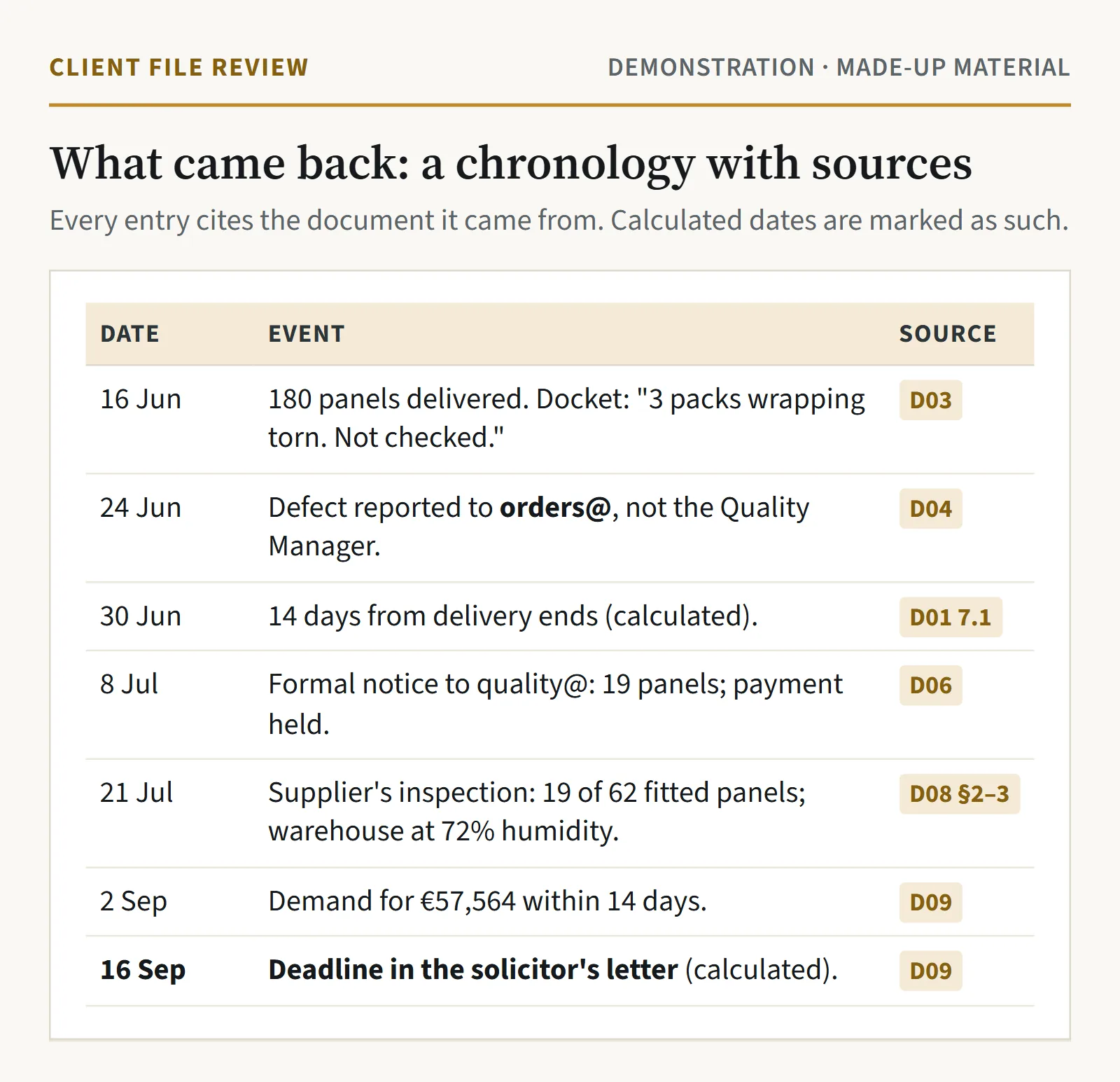
An excerpt of what comes back:
Date Event Source 16 Jun 2026 180 panels delivered to Ashgrove's warehouse. Docket: "3 packs wrapping torn. Not checked." D03 24 Jun 2026 Defect reported to orders@tullyvale.ie, not the Quality Manager: veneer lifting on 9 panels. D04 30 Jun 2026 Last day for notifying defects apparent on inspection (14 days from delivery). D01 cl. 7.1 (calculated) 8 Jul 2026 Formal notice to quality@tullyvale.ie: 19 panels affected; payment held. D06 16 Sep 2026 Expiry of the 14 days in the supplier's solicitors' letter. D09 (calculated) Claude also checked that the panel numbers add up: 62 installed plus 118 in the warehouse makes the 180 delivered.
3Ask for the key issues
What the person types Summarise the key issues: notice, cause, withholding payment, what Ashgrove can recover, the unused panels, and procedure. For each, say what the documents show on each side and where they conflict. Cite every point. Don't give a view on the law.
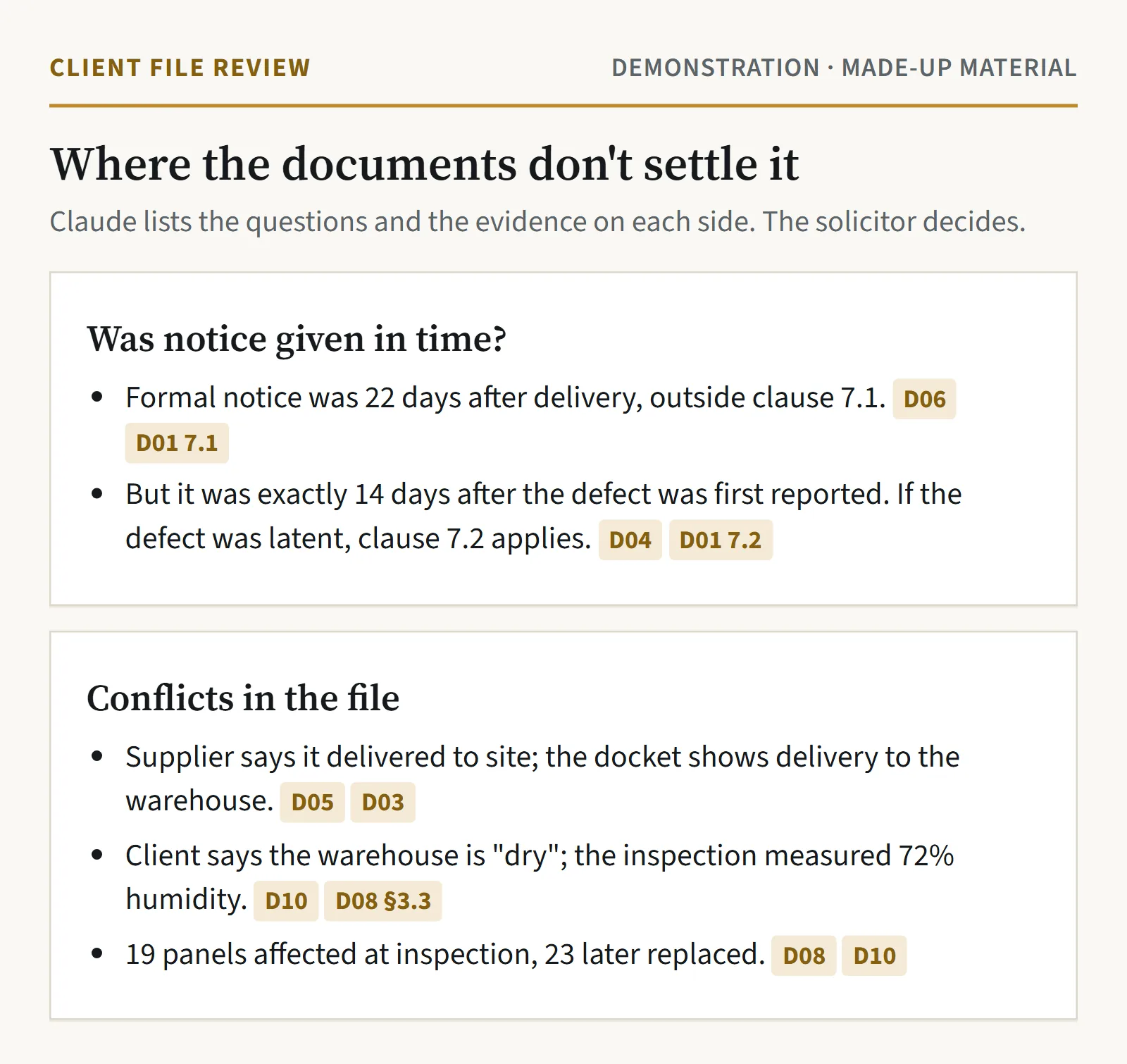
Claude set out six issues. The most useful finding is on notice. The supplier's solicitors say the formal notice came 22 days after delivery, outside the 14 days in clause 7.1. Claude noticed that 8 July is exactly 14 days after the defect was first reported on 24 June. If the defect was not apparent on inspection, clause 7.2 allows 14 days from discovery, and the solicitors' letter doesn't mention clause 7.2.
Claude also found conflicts inside the file:
- The supplier's sales director says they "delivered to" both sites while wet trades were going on (D05). The purchase order and docket show delivery to Ashgrove's warehouse (D02, D03).
- The client says her warehouse is "dry" (D10). The supplier's inspection measured 72% relative humidity, above the 65% maximum in the storage guidance (D08 §3.3, D01 Sch. 3).
- 19 panels were found affected at inspection (D08 §2.2), but the client says 23 were replaced (D10).
4Ask what needs a solicitor's judgement
What the person types List the points where the documents don't settle the answer and a solicitor has to decide. Phrase each as a question and give the sources.
Claude listed eleven. They include whether the defect was latent, whether the email to the wrong address counts as notice given that the supplier acted on it, whether the no-set-off clause and liability cap are enforceable, whether to pay the undisputed part of the invoice, and whether to commission independent testing. The supplier's own report recommends that testing.
5What the solicitor checks
- Checks the citations. Ruairí opens each cited document for the points he will rely on and confirms the quote or figure is there. Claude's citations make this quick, but it is still his job.
- Checks the calculated dates. He recounts the 14-day periods himself, because the notice argument turns on them.
- Forms the legal view. Claude deliberately gave no view on enforceability of the limitation and no-set-off clauses, or on the statutory terms implied into sales of goods. That analysis is his.
- Takes instructions on the points where the client's account conflicts with the documents (the "dry" warehouse and the 23 panels) before anything goes in a letter.
- Decides the strategy, keeping in mind that the client wants to keep the supplier, and replies before 16 September.
Time taken
A typical estimate, not a measured result
A trainee or junior solicitor would typically spend three to four hours reading a file like this and producing a chronology and issues note. With Claude, all three outputs come back in a few minutes. Checking the citations and calculated dates would take most solicitors under an hour. The legal analysis and advice take the same time as before. The difference is that the solicitor starts from an organised, sourced picture of the file, with the conflicts already found.
How this demonstration was made
We wrote the ten documents for this demonstration. Claude then produced the outputs by reading them. We checked every date, figure, quotation and document reference in the outputs against the source documents. In a firm's setup the documents would be added to a Claude Project, or read from the firm's SharePoint or OneDrive through the Microsoft 365 connector.
The source documents and Claude's full outputs are not published here. The excerpts and images on this page show what came back.
Claude features used, with Anthropic's documentation
- A Claude Project is a workspace with its own chat history and knowledge base. Documents added to it give Claude context for chats in that project, and each project can have its own instructions. Sharing projects with colleagues needs a Team or Enterprise plan. Claude Help Center: What are projects?
- With the Microsoft 365 connector, Claude can read Word, PDF and other files from SharePoint and OneDrive, using the user's own permissions. Claude Help Center: Enabling and using the Microsoft 365 connector
Doing this with your own work
For a real team we build the same kind of workflow in your Claude organisation, test it on your past work and train the people who will use it.
That is usually a workflow implementation. Ways to start sets out what it includes and what we need from you.
Talk to us about a piece of work like this
Tell us what the work is and who does it now. We'll suggest a time for a short call.